Skip to content
Age of Carthage
Preorder
Age of Carthage
LanguageENFR
Preorder

Every card is a confession

The dilemma

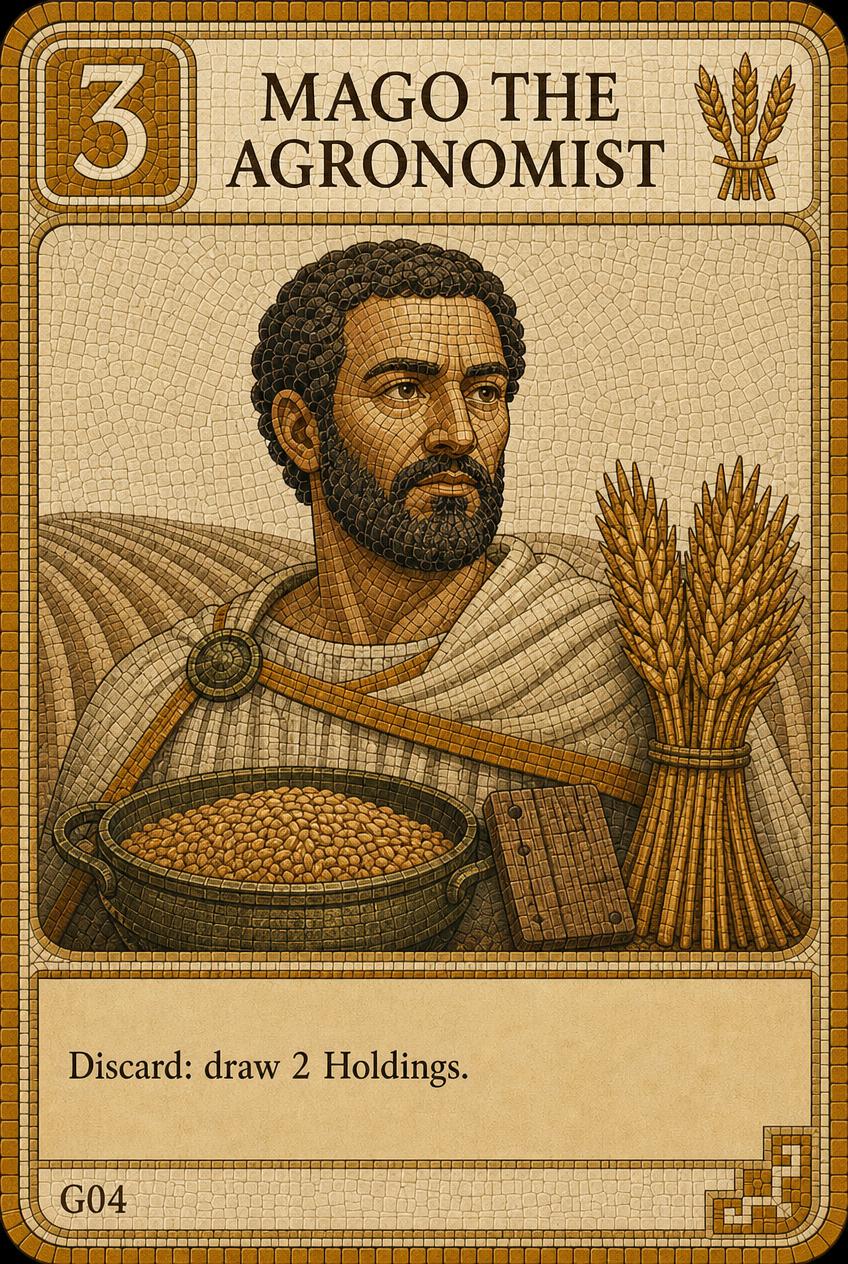
Every card in your hand is only worth something while it is in your hand. The second you give it to the city, it stops being yours. It goes on the table, face up, where everyone can see it. Forever. If Carthage is still standing at the end, the cards you kept are worth nothing. Only what you gave counts. If Carthage falls, it is the opposite. What you gave is worthless. Only what you quietly kept pays off. And you do not know which way it will go. Not while you are deciding. Nobody does. That is the whole game.
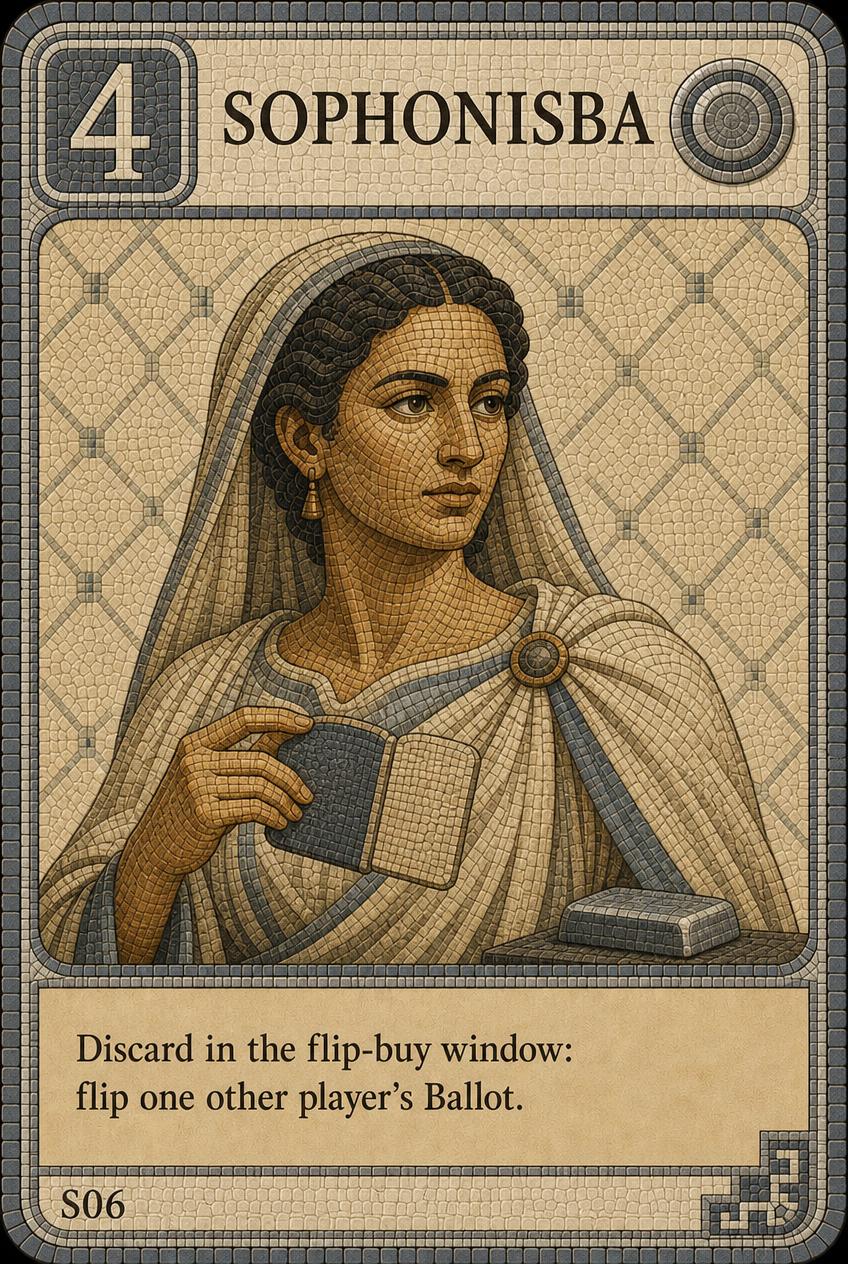
Kept in hand · S06 · Sophonisba
Given to the table · G04 · Mago the Agronomist

Five Pillars, and how a city falls

Carthage stands on five Pillars: the Cothon for its ships, the Granaries for its grain, the Walls of Byrsa for its soldiers, the Mint for its silver, and the Agora at the heart. Each trouble attacks one Pillar. Everyone gives in secret and flips at once. If the pile pays the cost, the Pillar holds. If not, the table gets one lap to add more. If it is still short, the Pillar falls, and the next blow to that family hits the Agora. Nothing falls quietly. The whole table watched.

Six Acts, and the game tells you what to say

The Acts have names: The Alarm, The Strain, The Doubt, The Whisper, The Last Coin, and The Siege. Each one opens with a line the Sufet reads out loud. In Act One you promise the city one thing. In Act Two you point to the player you trust most. In Act Three you point to the one hiding the biggest hand. In Act Four you make a promise to one player, and the card reminds you that promises bind nobody. In Act Five you ask someone straight out: will you stand or leave? They may lie. This is Table Talk. It means nobody sits silent, not even the shy player, not even the ten year old.

Act Six: say one word

Rome arrives. No cards can save you now. From the poorest player up, with the Sufet last, each of you says one word. STAND: your whole hand goes to the city. LEAVE: you keep it and walk out. Then count. If the players who stood outnumber the fallen Pillars by the margin, Carthage stands and the gifts pay. If not, the city falls and the hoards pay. With good play, the city stands about half the time, at every table size. That is not luck. It is the design, and The Method page shows the arithmetic.

Cato's Directive: Carthage against Rome

The second mode, for 4 or 6 players. Two fixed teams. Carthage wants the city to stand. Rome wants it to fall. Each Act, both teams build one secret pile, then flip. Carthage must pay the cost and beat Rome. The winner keeps the trouble as a prize. At the Siege, one last pile each, plus the prizes: the bigger total takes the city. And here is the rule that makes it: your own teammates cannot see your cards. You talk. You never show. The team game has one more thing going for it, proven on paper: if nobody fights, it ends in an exact tie, every time, whatever the cards. So somebody always has to fight.

Nothing is left to dice

There are no dice in the box. Every gift was decided before anyone flipped a card. The flip does not make the result. It shows you what was already true.

152 CARDS · 30 TO 60 MIN · 3 TO 7 PLAYERS · 2 MODES

Quick answers

How many players?

3 to 7 in the Council game. 4 or 6 in Cato's Directive, in two teams.

How long is a game?

30 to 60 minutes. Six Acts. The last one is a vote.

Is it cooperative or competitive?

Both at once. The table decides together whether the city lives, but only one ending pays each player. It rewards real help without promising that everyone wins.

What happens if the city falls?

Every card kept in hand becomes that player's score. Every card given to the city is worth nothing. If the city stands, the reverse.

Can you betray the others?

Yes. LEAVE at the Siege is the betrayal, and it happens out loud, in turn order, in front of everyone.

Where are the full rules?

On the How to Play page, on one card in the box, in English, French and Arabic.